Skip to content

Fish

  • Ocellaris clownfish

    Ocellaris clownfish

    Order: Perciformes
    Family: Pomacentridae

    Amphiprion ocellaris
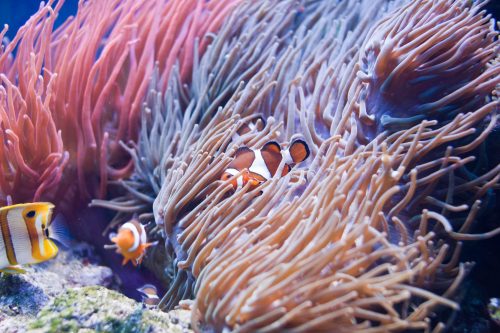
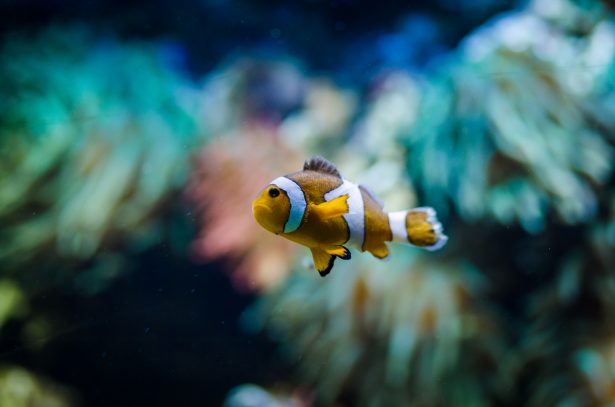
    Certainly Andrew Stanton contributed to the promotion of this fish, seeking inspiration for his new work, looking for a picture that would embody the magic of the ocean. While viewing photos of marine fauna, he came across two individuals of the spotted clown who live in symbiosis with anemones in their natural environment, which makes them a grateful object for observation both at home and in many zoos.

    When breeding clownfish, remember about sex variability. Within the herd, the largest and dominant individual becomes a female, and the next largest in size becomes male. Other fish persist in asexual form and stop their growth. Sex dimorphism is very pronounced in this fish. When the female dies, the mature male will change sex and become a female, and the next size individual matures sexually and becomes male. If in the breeding conditions a pair or several clownfish of the same size appears in the tank, the time is required for the emergence of the dominant individual due to competition in the group.

    The female lays eggs in the chosen place, which are fertilized by the male. Spawning is associated with the phases of the moon and should take place about every 27 days. Mature couple in favorable conditions will spawn periodically every several days. The standard factor that stimulates fish to breed is high food quality, which should be diverse. Parents should not be separated from laid eggs because they remove impurities and aerate the eggs by fanning their fins, which protects them from mold. Adult fish should be left with eggs for as long as possible. The juveniles hatch after about a week and intensively feed. If an aquarist would like to control the hatching time to some extent, one can darken the aquarium, because in nature the hatching occurs after dark. Growth is very slow. Properly fed clownfish reach 3-4cm in size at 6-8 months of age. The success in raising young clowns lies in frequent but reasonable feeding with living food.

    It is worth remembering to secure all filter inlets with a very fine plastic mesh or aquarium sponge so that increased water circulation does not lead to large losses in breeding. In larger aquariums (more than one species) other inhabitants of the tank can treat larvae and small fry as potential food.

    The ocellaris clownfish is one of the best known species of the genus Amphiprion, thanks to the movie “Finding Nemo?” Clownfish live in close symbiosis with anemones. It has been proven that thanks to a certain ingredient in the clown’s mucus, it is protected against burns by anemones. If the fish moved away from the host, it could quickly become a victim of predators. For protection, clowns repay by keeping the coral in good condition.
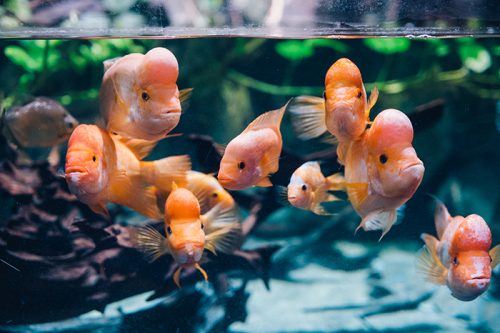
  • Midas cichlid

    Midas cichlid

    Amphilophus citrinellus

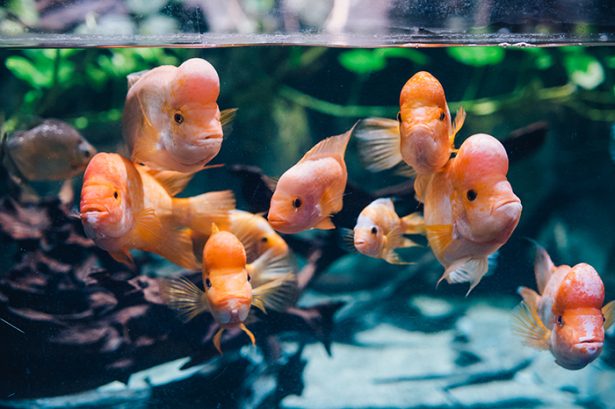
    The Midas cichlid belongs to the cichlid family (Cichlidae) – freshwater fish (except for one marine species). Most species of this family resemble perch – a stocky body, slightly jagged. As the family name suggests, these are fish that are characterized by exceptional care for offspring. Also interesting are their adaptations in terms of seeking a partner for reproduction. Among this family we will find various sizes, shapes and colors. The range of occurrence of some species is limited to one lake (strongly developed endemism).

    This freshwater fish in natural conditions usually has a less colorful coloration, however, most of them are bright orange and orange-red. Males appear with a tumor on the forehead, which indicates age and position in the herd. Cichlids reach a size of 25 cm. Couples of cichlids diligently guard their eggs and later offspring. While the female is guarding them, the male attacks every intruder who approaches them.

  • Butterlyfishes

    Butterlyfishes

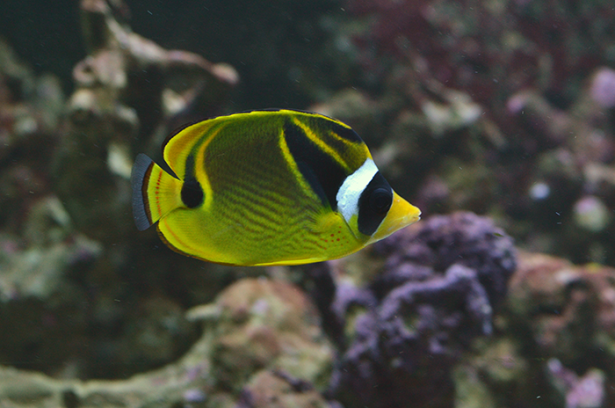
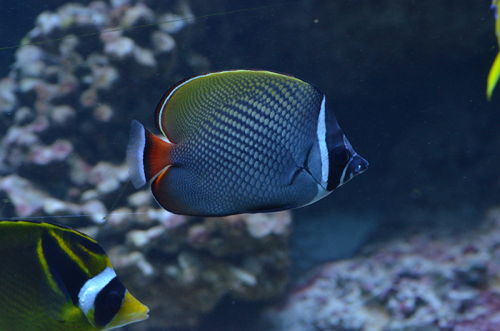
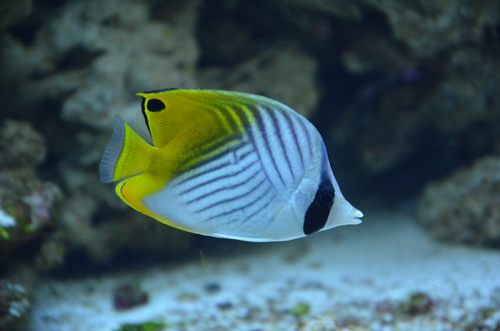
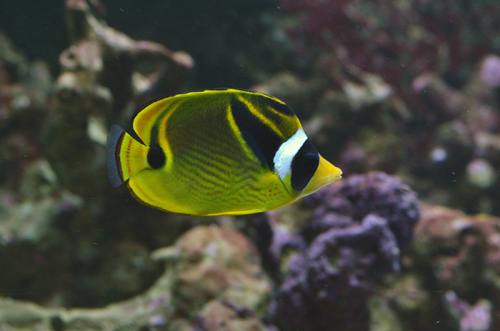
    Colorful representatives of the butterlyfishes (Chaetodontidae family) live among coral reefs, most commonly in the western Indo-Pacific. They differ in terms of color, but have common morphological features, such as laterally flattened body, characteristic fin shape, more or less elongated jaws. The shape of the mouth depends on the type of food consumed. They feed on small invertebrates, coral polyps, and algae.

    Chaetodon lunula

    The Raccoon butterflyfish is very easily recognizable due to the black mask he has, which is why he is often called a bandit. During the day, under natural conditions, it usually remains hidden, while at night it looks for food. His relatively large eyes are an adaptive effect to night life.

  • Electric eel

    Electric eel

    Electrophorus electricus

    Order: Gymnotiformes | Family: Gymnotidae

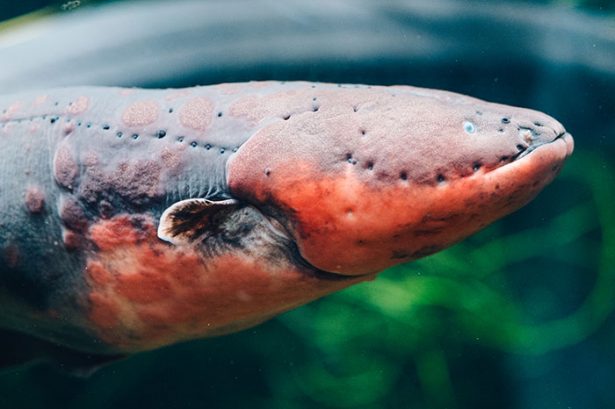
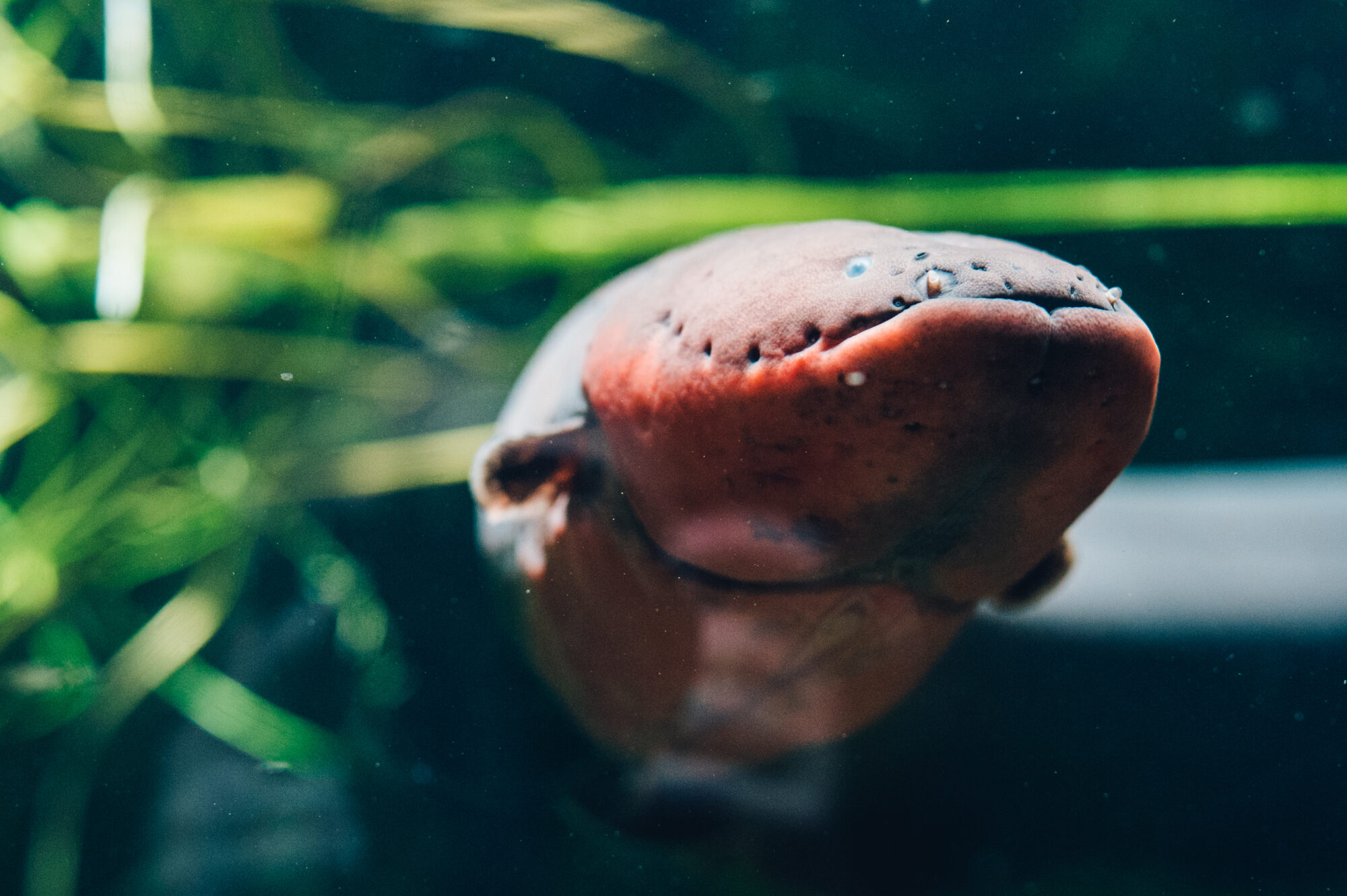
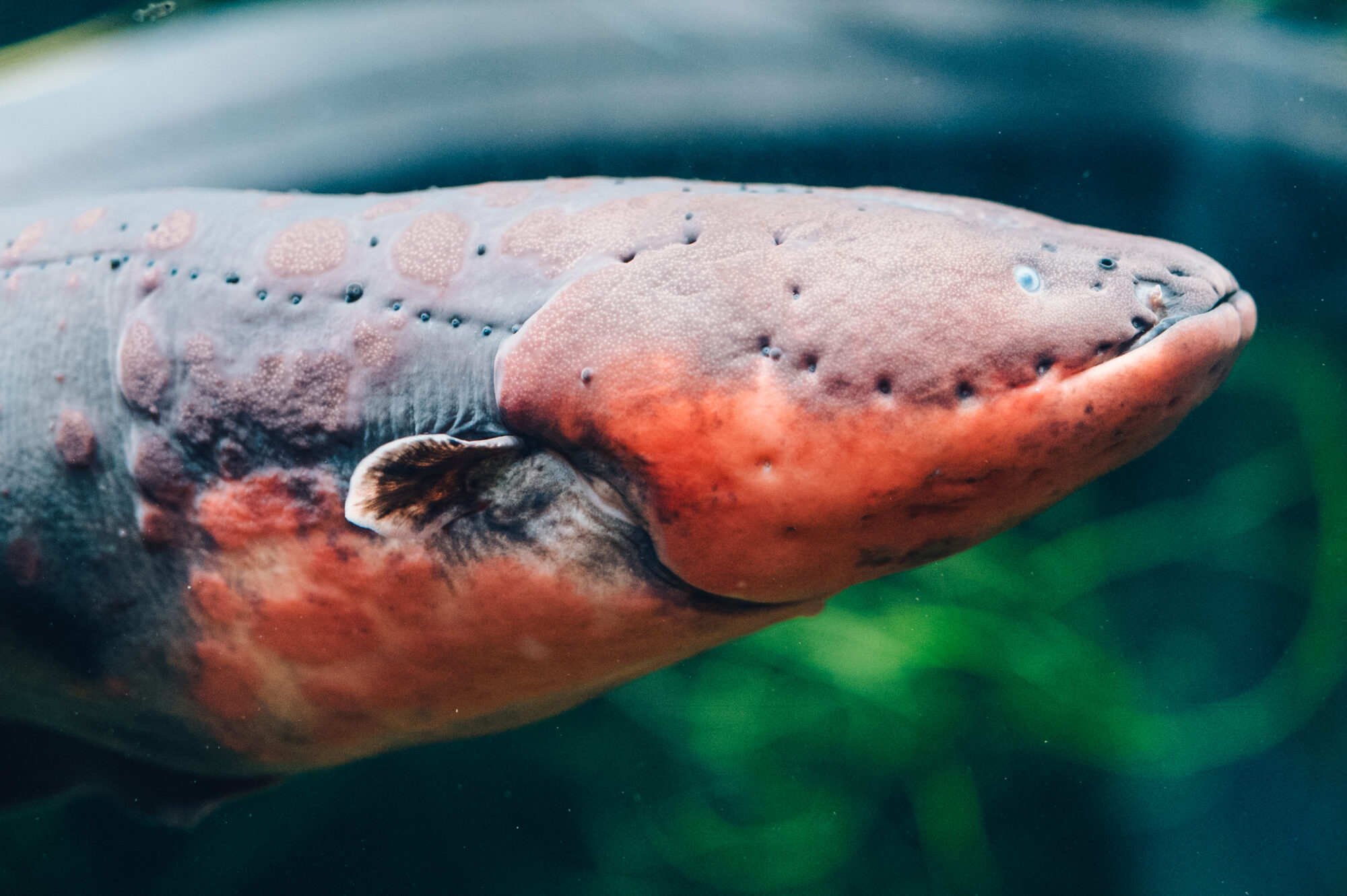
    This fish is commonly known as the electric eel. The name comes from the characteristic body shape that resembles an eel, but this fish is actually more closely related to the families Cyprindae and Siluriformes. These fish can be found in the waters of the Amazon River and the Orinoco River. They live in muddy currents enriched in salts and minerals that conduct electricity really well.

    They have a positive charge near their head and a negative one close to their tail end. They produce an electric charge at the front of their body that comes back through the water to the tail. This creates a closed circuit that has the shape of an electric cloud which paralyzes or kills everything around.

    There are electrolytes on the body of this fish, which receive electric stimuli from their surroundings. This is called electroreception. With the use of their special Hunter and Sachs organs, they send two types of electric discharges. Sachs’ organ is used as radar for electrolocation. The lower voltage of this organ helps them move through the muddy waters, which is especially useful because they lose their sight with age. Sachs’ organ is also used for sensing potential prey and partially blinding it, if the prey is small. This organ also plays a major role in finding a partner. When attacking larger prey, the eel activates Hunter’s organ, which produces a stronger discharge.

    This fish can regulate the strength of discharges according to its needs and the size of the prey. The strongest discharge ever captured was in a zoo in the United States and measured 600 V.

  • Red lionfish

    Red lionfish

    Order: Scorpaeniformes
    Family: Scorpaenidae (scorpionfish)

    Pterois volitans

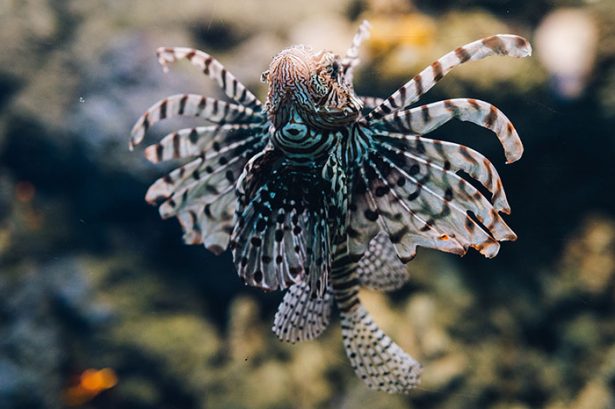
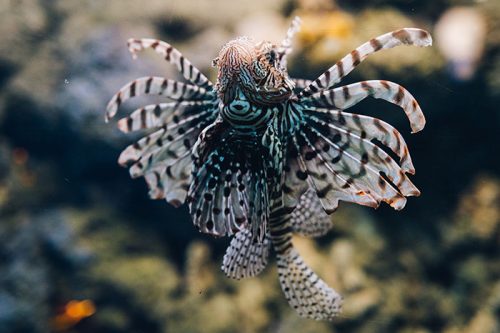
    The Red lionfish inhabits the western Pacific, from southern Japan to Australia and the Philippines. Occurs on the hard bottom on the outskirts of reefs and lagoons. It can be found already at the water surface and at a depth of 175 meters. This fish lives about 10 years, reaching a body length of up to 30 cm. Its food are crustaceans and fish. The Red lionfish uses different strategies for obtaining food. Due to the fact that its swim bladder is surrounded by special muscles, it can control her level in the water column and change the center of gravity of the body so as to take a precise position before attacking the victim. In addition, it flushes invertebrates from the bottom using pectoral fins. Additional muscles around the swim bladder also allow it to turn upside down and freeze under the rock shelves, where it waits for the victim. It is mainly active at night and usually hides during the day.
    After eating a large meal, its stomach can increase up to 30-fold, thanks to which it is able to fast for several weeks.

    It leads a solitary life. Schools of up to 8 individuals gather only for breeding purposes. The female can lay up to 15,000 eggs, and its pelagic larvae can travel long distances, e.g. eggs laid in the Bahamas can reach New England along with the Gulf Stream. It has a characteristic white-red-black coloration that adapts to the surroundings. The bright stripes on her body signify that it’s dangerous. At the base of each stiff ray of its fins is a gland with a venom, except for the caudal fin. The venom contains neurotoxin, which, if pricked, can lead to death. It is a commercial species. It is consumed after removing the fins with the poison, the meat is a delicacy.

    The Red lionfish as an invasive species

    It is the only alien species that managed to survive in the waters of the West Atlantic. Adult lionfish occur along the east coast of the USA from Cape Hatteras in North Carolina to Florida, Bermuda, Bahamas and the entire Caribbean, as well as in the Gulf of Mexico. Its expansion began in 1985 in Florida, most likely it was thrown into the ocean from a home aquarium. Currently, the highest density of P. volitans has been observed in the Bahamas. Its numbers are several times higher than in its natural environment. In this area it was observed at a depth of 300 meters. Its body length is greater than that of individuals from the natural environment and reaches up to 50 cm. Its food consists mainly of fish, which are also food for economically important species of Atlantic fish. Another problem is the fact that it is more voracious than native predators of similar size. One Red lionfish can eat more than 20 young fish in just half an hour, very often eating the juvenile forms of important species of reef fish, such as parrotfish, which is responsible for maintaining the proper functioning of coral reefs. The Red lionfish has all the features necessary for the successful colonization of new areas. It is characterized by high competitive ability, low susceptibility to parasites, high reproductive rates, rapid growth, effective food acquisition, the presence of venom spines protecting it from predators and adaptation to any habitat.


  • Australian marbled catshark

    Australian marbled catshark

    order: Carcharhiniformes
    family: Scyliorhinidae

    Atelomycterus macleayi

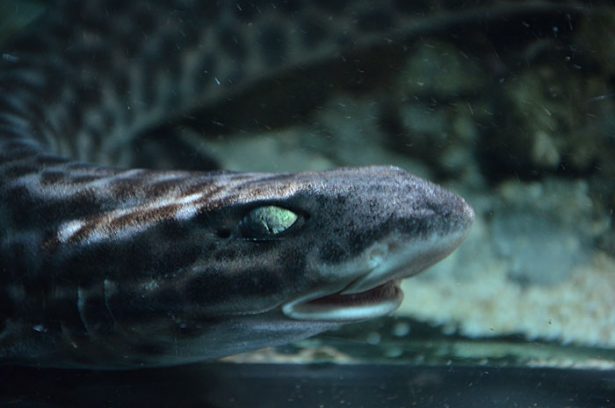
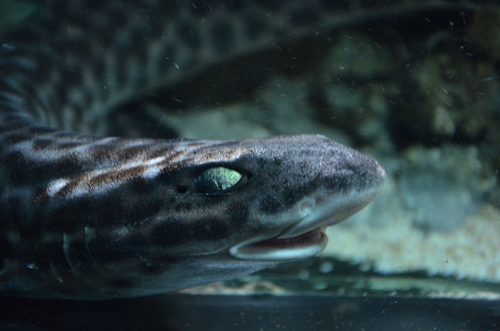
    It is a poorly known endemic species of northwestern Australia, inhabiting coastal areas from Port Hedland in the west to Melville Island in the north. It lives in shallow waters up to 4 meters deep, although it can also be found at greater depths. It is closely associated with the bottom. It prefers a sandy bottom or covered with rocks, among which it looks for shelter. This is one of the smaller sharks, the maximum total length of his body is 60 cm. Its diet includes polychaetes, molluscs, crustaceans and small fish. It has a rounded muzzle, and its slender, brown body is covered with wide, gray stripes separated from each other by light areas. Very often the dark areas are outlined with numerous black dots that can merge and form an irregular line. Juveniles have a simpler pattern, only with broad dark stripes. It has no commercial value. As it is associated with the bottom habitat, it is not caught as a by-catch in commercial fishing.

    What does reproduction of the marbled shark look like?

    This question will be answered by our aquarists who deal with these sharks on a daily basis. It is our pride that the marbled shark successfully breed in the Gdynia Aquarium. Below we present the backstage of courtship and efforts of aquarists to ensure that the incubation of the embryo in the egg proceeds correctly.

    The courtship and fertilization take place in the exhibition tanks. Courtship is very violent and looks almost brutal. The male chases his partner, bites her and tries to knock her over.

    „This pursuit can be observed during the day, but the act of fertilization itself takes place at night. During the reproductive cycle, the female lays 2 eggs daily. We harvest the newly laid eggs and transfer them to breeding tanks in which conditions are suitable for their incubation. The tanks have special racks to which we attach eggs with their tacking barbles. It is also important that water flows around the eggs, as it washes and oxygenates them at the same time. After about 50 days, the eggs are gently “unsealed”, then the embryo is no longer tightly closed in its shell. Thanks to this unsealing, it lives and functions in the water that surrounds it (therefore it is vital to regularly replace water!). Incubation lasts about 90-100 days. At the end of the incubation period, the young shark ceases to fit in its shelter. The capsule is drilled and bitten. If it won’t be able to get out of the egg, it may end in death for small shark, so it’s important to watch it closely at this time. Often the young hatch with the remains of the yolk sac attached to the abdomen, which will be absorbed within a few days. During hatching, young marbled sharks are about 10 cm long. We transfer the newly born individuals to another tank. Each litter has its own tank, thanks to which we avoid situations in which older and stronger individuals would steal food from younger and weaker ones. We begin feeding attempts by giving them zooplanktonic animals, first living, then frozen. The next step is to try to give them clams, shrimps and chopped fish. The juveniles have special hiding places in their tanks. As a secretive species they need this kind of places.”

Skip to content