Skip to content

gdynia aquarium

  • Banded archerfish

    Banded archerfish

    Order: Perciformes
    Rodzina: Toxotidae

    Toxotes jaculatrix
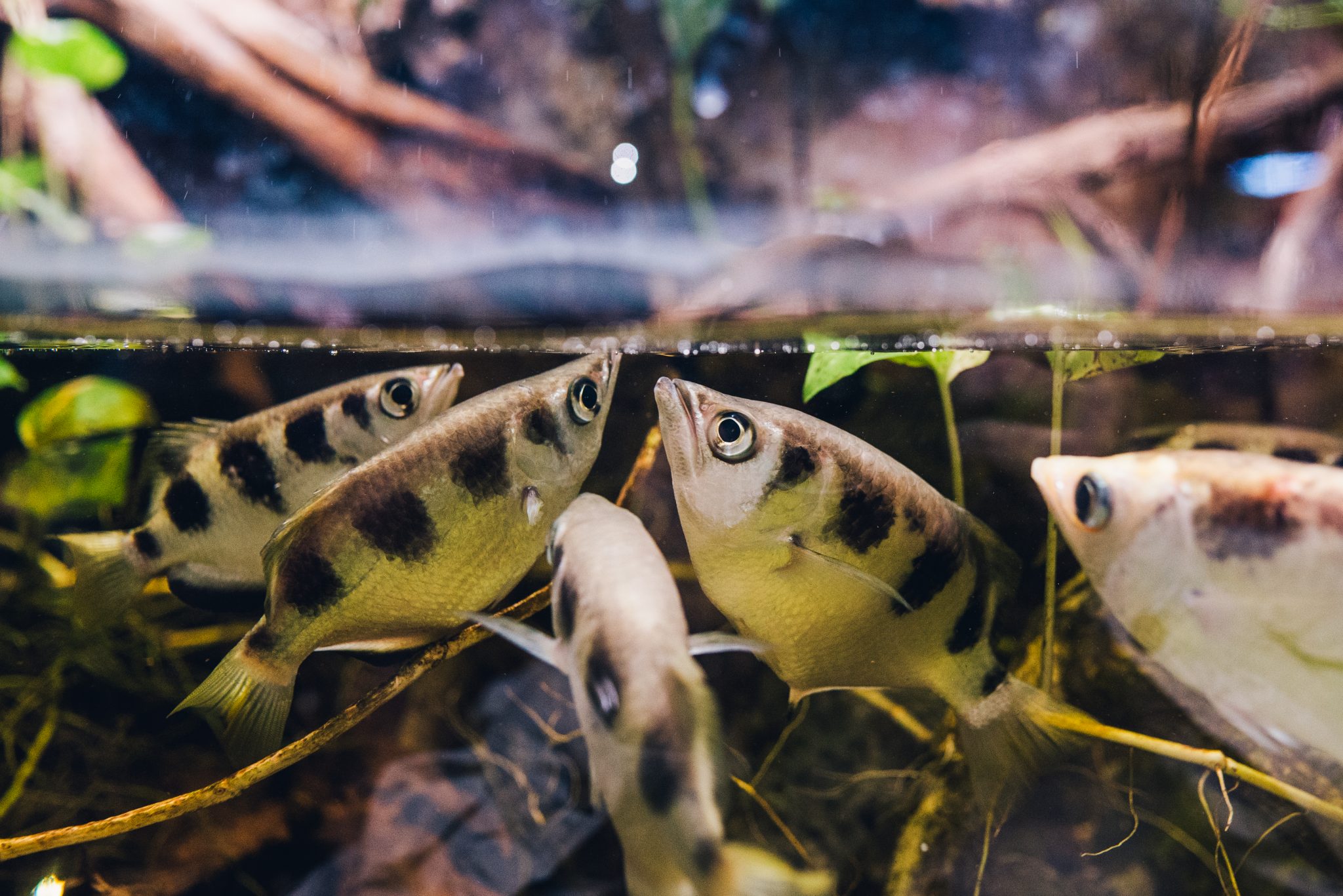
    This species is found in Indo-Pacific waters, from India, through Southeast Asia, Indonesia, Philippines, New Guinea to Australia. It tolerates  changes in salinity, so it can be found in fresh, brackish and salt waters. However, it prefers the brackish waters of the mangrove forests, but also lives in small streams and rivers, as well as near vegetation on coral reefs.

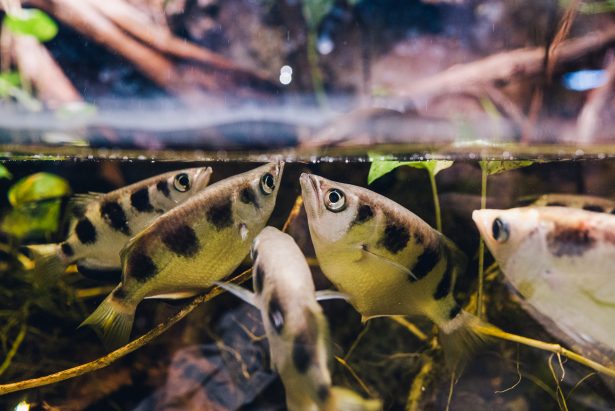
    It is a calm fish that lives in small flocks just below or near the surface of the water. If the fish is left without a group, it becomes aggressive towards other fish. The maximum length of the Banded archerfish’s body is 30 cm, however, they usually grow up to 25 cm. In captivity, they reach a smaller body size, about 16 cm and can live from 5 to 8 years, and sometimes even 10. Its body is oblong and raised from the back. The body is generally silver-white, although it may also be yellow. The back is green-olive or brown. The dorsal fin is yellow-green, the caudal fin is earthy green, and the anal fin is silver. On the sides of the body there are wide, black stripes (4 or 5), which shorten as the fish ages. Juveniles have a silver body with a yellow-green or brown back. The archerfish’s eyes are large and set so that he can look forward.

    It is omnivorous, the basis of its diet are land insects, molluscs, crustaceans, small fish and plants. Actively hunts its prey by shooting insects on the vegetation above the water surface with a stream of water spewed from the mouth.

    It can shoot an insect from a distance of 1.25 meters, and larger specimens are able to hit the victim from a distance of 2-3 meters. It is able to reach the victim within 50 milliseconds after it hits the water. It can also jump above the water and catch an insect on the fly.

    It is a dioecious, oviparous animal with external fertilization. The first reproduction occurs when the animal is 10 cm long. During spawning, which takes place in November and December, the female lays between 20,000 and 150,000 eggs, with fertility closely related to the size of the female. They rarely reproduce in captivity. They plays insignificant role in commercial fishing, but are also caught as an aquarium fish.

    Indian shooter – sniper fish

    The archerfish can see a clear picture despite the different refractive index on the water-air interface. It does this through special adaptations in the eye with an extremely large retina on which the image focuses. This allows the fish to look through the water into the air without having to take into account the distortions in the spatial system, resulting from different refractive indexes, and give an accurate shot. Another possible way how a shooter deals with minimizing refractive indices is to position itself almost directly under its prey before the shot, then it sees the same picture he would see from the air.

    The way it shoots its victim is also important, unfortunately it is not known in detail. It is known that a shooter is able to spit water by exerting pressure in the mouth. A stream of water is generated in a tube formed from the tongue hooked on the groove in the palate. Water is thrown out of the mouth by high pressure due to the contraction of the gill chamber. The length of the water stream shot by the fish can reach up to 3 meters.
  • Red piranha

    Red piranha

    Order: Characiformes

    Family: Serrasalmidae

    Pygocentrus nattereri

    This species of freshwater fish is common in South America, where it occurs in the rivers of Argentina, Brazil, Bolivia, Colombia, Ecuador, Guyana, Paraguay, Peru, Uruguay and Venezuela. It lives in the warm waters of several major rivers, such as the Amazon, Paraguay, Parana and Essequibo, as well as in many smaller ones. It prefers rivers rich in mineral substances that give the water a white color, only sporadically seen in rivers with a very low pH and high content of humic and fulvic acids, whose waters are black. The Red piranha inhabits coves, floodplains, lakes, streams and large rivers, up to a depth of 20 meters.

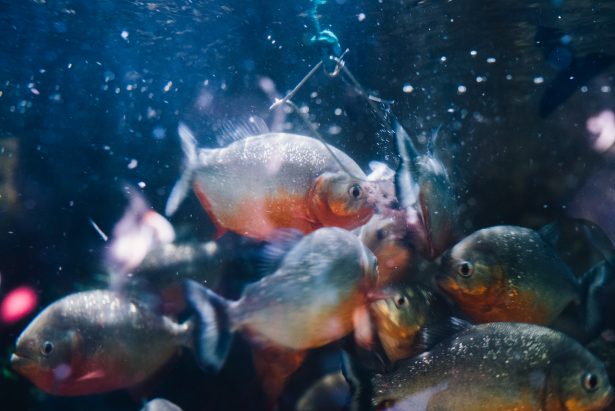
    It grows up to a maximum length of 50 cm, but rarely exceeds 35 cm, and a maximum weight of 3.9 kg. It is characterized by a deep, laterally compressed body with long dorsal fins. The coloration varies depending on the geographical location and age of the fish. Mature individuals have a gray-silver body with a reddish-orange belly. The dorsal, anal and caudal fins are black, while the pectoral and abdominal fins are red-orange. Juveniles, on the other hand, have a silver body with dark spots, which disappear gradually as the fish grows.

    It lives in groups of about 20-30 fish. Interestingly, they do not group to hunt for large victims collectively, but for protection against larger predators. However, provoked or starving, they can go into a feeding spree, then several groups of piranhas gather around the victim and eat it within a few minutes.

    Such attacks are extremely rare. Despite the opinion of a dangerous predator, it is omnivorous. A typical diet of red piranha includes insects, molluscs, crustaceans and other fish, as well as plants and carrion. The feeding time varies depending on the size of the fish. Smaller fish search for food during the day, while larger ones feed at dawn and late afternoon and evening. Usually hunts waiting for prey hidden among the vegetation, but can also actively pursue prey. Its powerful teeth can cause serious bites.

    The Red piranha is not a migratory species, but travels in search of conditions favorable for reproduction and spawning during periods of increased rainfall. It is a dioecious animal. The male can be distinguished from the female by the cross-sectional shape of the abdomen. In males it has the shape of the letter “V”, while in females “U”. In addition, the female belly has a slightly deeper shade of red. Piranha has two breeding seasons per year that are associated with water level fluctuations. When the individual is ready for sexual activity, it loses its red color and selects spawning habitat such as vegetation floodplains. This animal shows breeding behavior around nesting sites, then two different sexes swim side by side being in close contact with the abdominal sides. Initially, they were thought to be courtship, but this behavior was to defend the nest. The nests are about 4-5 cm deep, 15 cm in diameter and are dug among grass. The female lays up to 5000 eggs, which she sticks to the vegetation in the nest. After a few days of fertilization, how are young individuals hatching who seek shelter from predators among the vegetation. Juveniles will reach puberty after one year.

    The Red piranha is considered one of the more dangerous and aggressive species of piranha, but it has developed a kind of symbiotic relationship with another piranha agent – Serrasalmus marginatus, which cleanses its body of parasites. It can be dangerous to people due to the risk of biting. It is the most commonly caught species of piranha used commercially as aquarium fish. Its fishing and trade as an aquarium animal can locally reduce the number of this species.

    Fish and children don’t have a say – do they?

    The Red piranhas can communicate with each other. Very often the issuing of sounds manifests itself along with aggressive behaviors, such as biting, racing or fighting. The sounds produced by piranhas are generated by muscle spasms and are associated with a swim bladder that serves as a resonator. When removed from the water, piranha makes a drumming-like sound. Three other types of sounds are made in the aquatic environment and vary in frequency and duration depending on the circumstances. They will be different when two individuals meet, before a fight or during a pursuit or just before a bite. Almost all sounds made by piranhas are produced in the context of social interaction. Low sound is usually produced during moderate attacks, while loud, high sounds are generated during more energetic attacks.

Skip to content